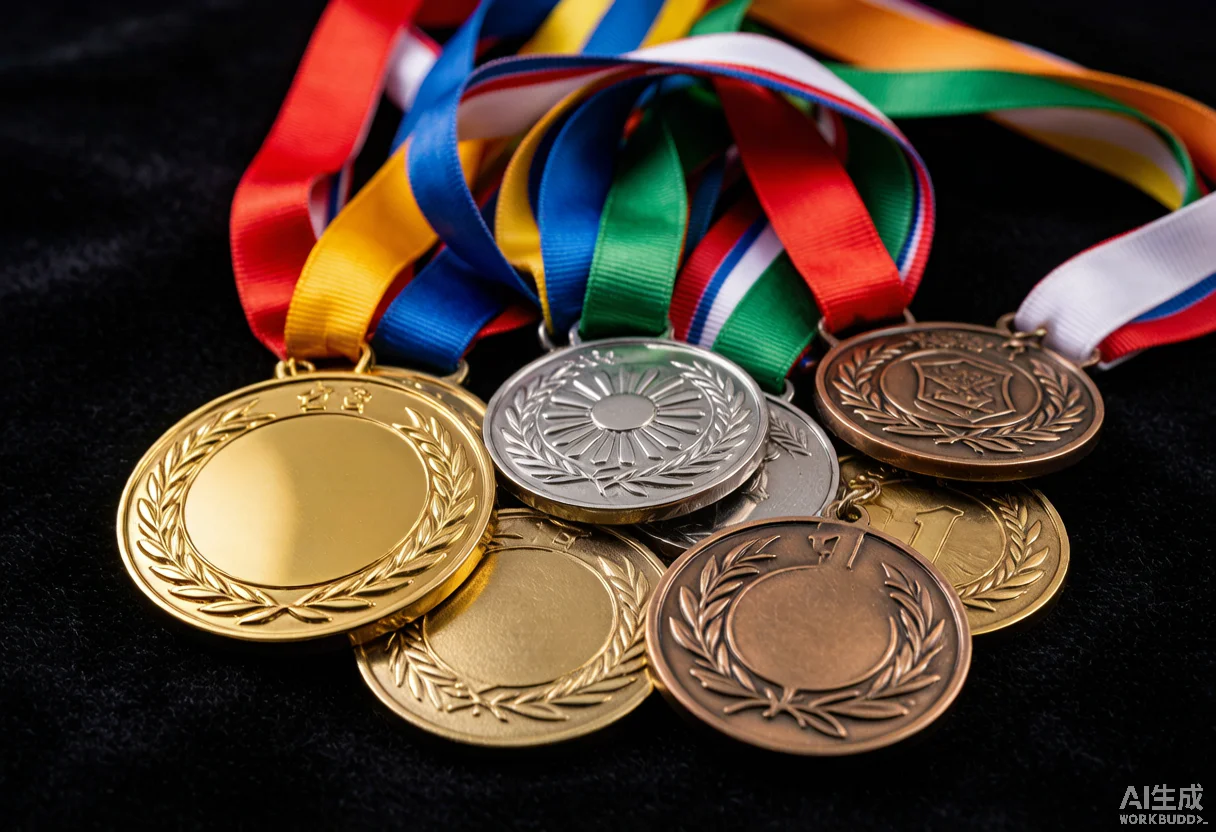
Producing a custom medal is a multi-stage engineering exercise that spans concept design, tooling fabrication, metal casting or stamping, surface finishing, color application, ribbon assembly, and final packaging — each step carrying its own quality checkpoints and cost implications. Whether you are commissioning medals for a marathon finish line, a corporate awards ceremony, a military decoration program, or an academic recognition event, understanding the end-to-end OEM production process is what separates a seamless procurement experience from a timeline of missed deadlines and quality disputes.
This guide follows a medal from the initial design brief through every production stage to final delivery, providing the technical detail, pricing data, and quality benchmarks procurement professionals need to manage a medal sourcing project with confidence.
Types of Custom Medals
Medals serve vastly different purposes, and the production approach adjusts accordingly.
Sports Event Medals — Marathon, triathlon, cycling, and tournament medals. Typically 60–80mm in diameter, 3–5mm thickness. Die cast zinc alloy with 3D sculpted relief. Bright polished plating with soft enamel color accents. Custom ribbon with event branding. Quantities: 500–50,000 pieces per event.
Corporate Award Medals — Employee recognition, sales achievement, service anniversary awards. Clean, professional aesthetics. Die struck brass or zinc alloy with polished or antique finishes. May incorporate engraved recipient names. Quantities: 50–2,000 pieces per design.
Commemorative Medals — Anniversary pieces, memorial medals, dignitary gifts. Highest attention to detail with premium materials. Hard enamel (cloisonné) or antique finishes. Often presented in velvet-lined display cases. Quantities: 100–5,000 pieces.
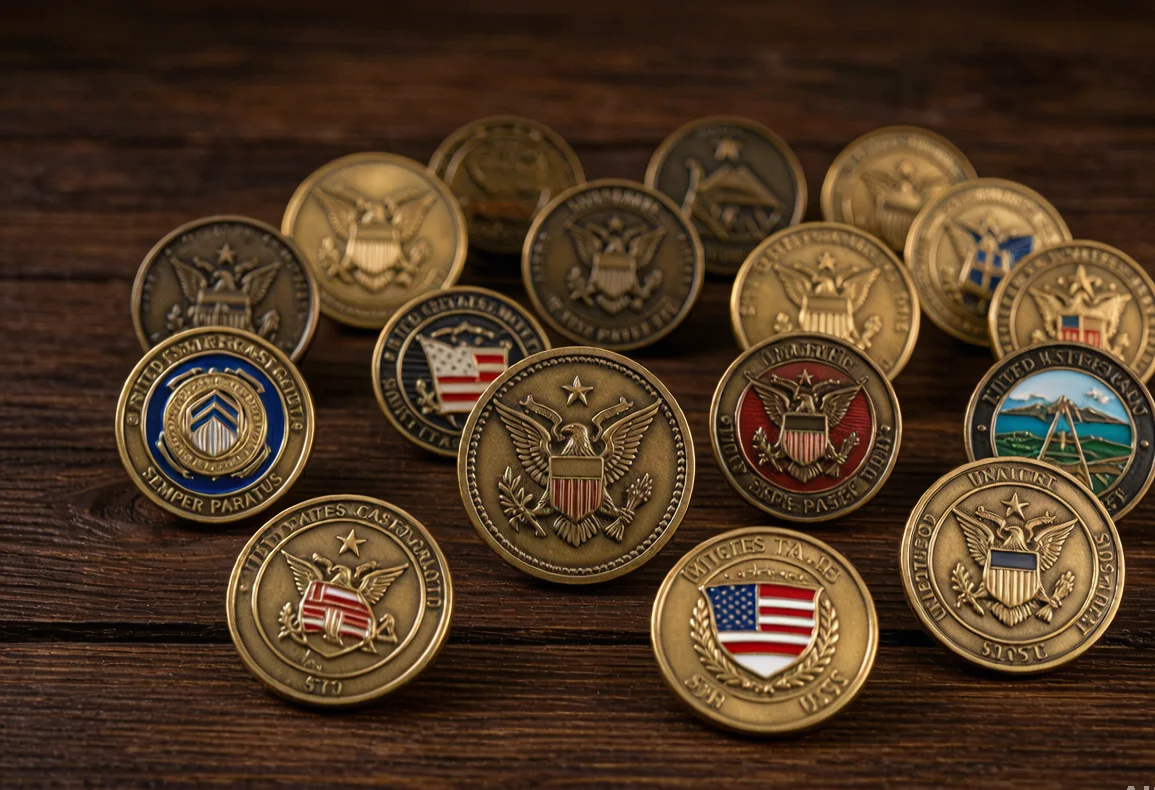
Military and Law Enforcement Medals — Service medals, campaign medals, valor decorations. Regulated specifications for size, ribbon design, and material composition. Die struck brass or copper with precise relief detail. Quantities: 500–10,000+ pieces.
Academic Medals — Graduation honor medals, science fair awards, debate tournament medals. Budget-conscious production with standard zinc alloy, soft enamel colors, and simple ribbon designs. Quantities: 200–5,000 pieces.
The Design Phase: From Concept to Production File
The design phase is where 80% of production quality is determined. A well-prepared production file eliminates ambiguity and reduces back-and-forth between buyer and manufacturer.
Concept Brief — Provide the manufacturer with: medal purpose (event type, occasion, audience), reference images of styles you like, approximate dimensions (diameter and thickness), color preferences (Pantone numbers if known), and ribbon requirements (color, width, print detail). The more specific the brief, the more accurate the initial design proposal.
3D Relief Modeling — For die cast medals, the 2D design is converted into a 3D digital relief model using CAD software (typically Rhino or ZBrush). This model defines the relative height of every design element — foreground elements stand proud, background elements recede. The relief map determines how the CNC engraver will cut the mold cavity. 3D modeling cost: $50–$150 per design, often included in the mold fee by full-service manufacturers.
Artwork Format Requirements — Vector files are mandatory for both die struck and die cast production: Adobe Illustrator (.ai), CorelDRAW (.cdr), or EPS. Raster images (JPEG, PNG) cannot be used for die or mold creation. Include: the medal face design with Pantone color codes, a metal/enamel separation layer (black = enamel areas, white = bare metal), a cut-to-shape outline if the medal is not round, and the reverse side design if the medal is double-sided.
Die Lines and Tolerances — Minimum line thickness: 0.3mm. Below this, die cast metal may not fill the mold cavity completely, and die struck relief may be indistinct. Minimum text size: 6pt. Text smaller than this risks filling with enamel and becoming illegible. The manufacturer’s pre-production artwork review will flag any design elements below these thresholds.
Material Selection
| Material | Weight (70mm) | Detail | Corrosion Res. |
|---|---|---|---|
| Zinc Alloy (Zamak 3) | 80–100g | Excellent (3D cast) | Very good with plating |
| Brass (C26000) | 120–150g | Excellent (die struck) | Excellent |
| Copper | 130–160g | Very good | Good (patina risk) |
| Iron | 110–140g | Good | Requires plating |
| Stainless Steel | 120–150g | Good | Excellent |
| Material | Relative Cost | Best For |
|---|---|---|
| Zinc Alloy (Zamak 3) | Standard | Sports medals, corporate awards |
| Brass (C26000) | Premium | Military medals, commemorative medals |
| Copper | Premium | Antique-finish commemorative pieces |
| Iron | Budget | Budget sports medals, promotional items |
| Stainless Steel | Premium | Outdoor/marine event medals |
Zinc alloy (Zamak 3: 96% zinc, 4% aluminum) is the standard material for die cast sports medals. It flows smoothly at 400°C, filling intricate mold cavities with high fidelity. A 70mm zinc alloy medal weighs approximately 85–95g — substantial enough to feel premium without excessive shipping costs.
Brass (C26000 cartridge brass: 65% copper, 35% zinc) is the traditional material for military and high-end commemorative medals. It die strikes with exceptional sharpness and develops a natural patina valued by collectors. A 70mm brass medal weighs approximately 130–140g, nearly 50% heavier than its zinc alloy equivalent.
Iron is the most economical option for large-quantity promotional medals. It must be thoroughly plated (typically nickel undercoating with gold or silver topcoat) to prevent rust. At 70mm, an iron medal weighs approximately 120–130g.
Manufacturing Methods
Die Cast Medal Production
Die casting accounts for approximately 70–80% of all sports and corporate medal production. The process creates medals with deep 3D relief and variable thickness across the design.
Mold Fabrication — A steel mold is CNC-machined from the 3D relief model. The mold consists of two halves (cavity and core) that close together during injection. Mold cost: $250–$500 per design, depending on size and complexity. Mold production: 5–8 days.
Zinc Injection — Molten zinc alloy at approximately 400°C is injected into the mold under 50–80 MPa of pressure. The metal fills every cavity detail and solidifies within seconds. The casting machine cycles every 15–30 seconds, producing 2,000–5,000 castings per day from a single mold.
Deburring and Polishing — Raw castings are removed from the mold with sprue and runner still attached. These are cut away, and the casting edges are filed smooth. The medal surface is then polished using vibratory tumbling or manual buffing wheels to achieve a smooth base for plating.
Die Struck Medal Production
Die struck medals are produced by compressing a solid metal blank between two hardened steel dies under extreme pressure.
Die Creation — The medal design is engraved as a negative relief into a pair of hardened steel dies (obverse and reverse). Die cost: $150–$350 per design. Die production: 5–7 days.
Blank Preparation — Metal sheets are cut into circular or custom-shaped blanks matching the die dimensions. Blank thickness: 3–5mm for standard medals.
Striking — The blank is positioned between the dies and struck at 150–400 tons of hydraulic pressure. The metal flows into every crevice of the die engraving. Multiple strikes may be applied for deep relief. The struck medal is then trimmed to its final perimeter using a cutting die.
Comparison: Die Cast vs. Die Struck Medals
| Attribute | Die Cast | Die Struck |
|---|---|---|
| Detail capability | Excellent 3D sculpted relief | Excellent crisp, flat-surface detail |
| Production speed | Faster (injection cycle) | Slower (strike cycle) |
| Material options | Primarily zinc alloy | Brass, copper, iron, stainless steel |
| Edge thickness variability | Yes (mold-defined) | Uniform (blank-defined) |
| Mold/die cost | $250–$500 | $150–$350 |
| Best for | Sports medals, 3D sculpted designs | Military medals, coin-like precision |
| Weight consistency | ±5% tolerance | ±2% tolerance |
Enamel and Color Application
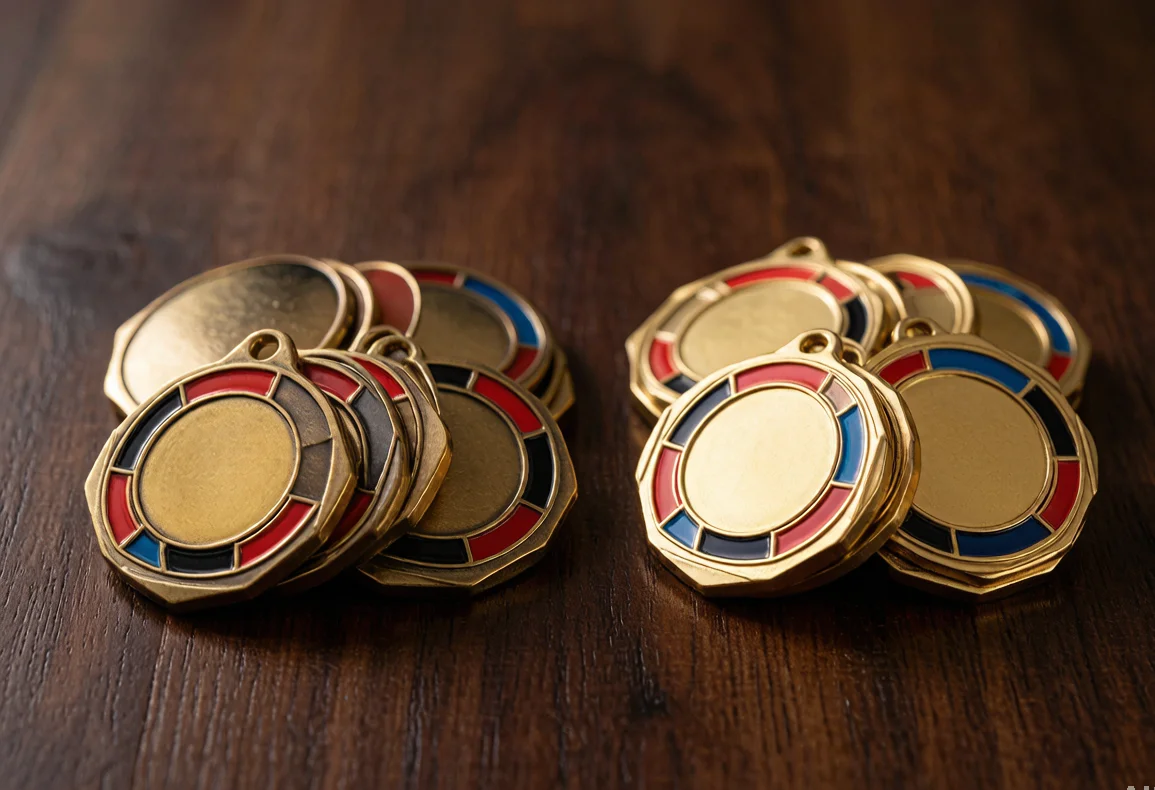
Soft Enamel — Colored enamel is dispensed into recessed areas of the medal using fine-tipped syringes or automated filling machines. After filling, the medal is baked at 120–160°C for 15–20 minutes. The enamel cures slightly below the metal ridge lines, creating a textured surface. One to two fill cycles are standard. Soft enamel is the default choice for sports medals: vibrant, cost-effective, and fast to produce.
Hard Enamel (Cloisonné) — Enamel is filled, baked, and stone-polished flat in 3–5 repeated cycles. The finished surface is completely smooth with no texture — enamel and metal sit at the same height. This jewelry-grade finish adds 3–5 production days and approximately 20–40% to unit cost. Reserved for premium and commemorative medals.
Imitation Hard Enamel — Soft enamel topped with a clear epoxy dome that is polished flat. Achieves the visual appearance of hard enamel at lower cost and faster turnaround. Popular for corporate medals where a smooth look is desired but budget is a constraint.
Screen Printing with Epoxy Coating — Direct ink application onto the metal surface via screen printing, followed by a protective clear epoxy dome. Enables photographic gradients and fine text beyond enamel capabilities. Less durable than enamel (ink can wear with abrasion). Used for medals with complex sponsor logos or photo-realistic elements.
No Color (Die Struck Only) — The design is conveyed entirely through raised and recessed metal surfaces, polished to highlight contrast between bright and frosted areas. Classic, formal, and timeless. Standard for military campaign medals and high-end commemorative pieces.
Plating and Finishing Options
| Finish | Process | Appearance | Best For |
|---|---|---|---|
| Polished Gold | Electroplating + buffing | Bright, mirror-like gold | Sports winner medals |
| Antique Gold | Gold plating + chemical oxidation | Muted gold, dark recesses | Commemorative medals, military medals |
| Antique Silver | Silver plating + chemical oxidation | Weathered silver | Historical society medals |
| Antique Copper | Copper plating + oxidation | Rich warm brown patina | Heritage and vintage-themed medals |
| Nickel | Electroplating | Cool silver-grey, matte or polished | Corporate awards |
| Black Nickel | Electroplating | Dark gunmetal grey, contemporary | Modern event medals |
| Dual Plating | Two selective plating processes | Two-tone contrast (e.g., gold + silver) | High-end presentation medals |
| Chrome | Electroplating | Bright white, highly reflective | Automotive or technology-themed medals |
Antique finishes are the most popular choice for medals with fine detail because the chemical darkening agent settles into recessed areas, dramatically enhancing contrast and making every design element clearly visible. Polished finishes are preferred for medals where a clean, high-energy aesthetic is required — particularly sports winner medals.
Ribbon Selection and Assembly
The ribbon is an integral part of a medal’s design and functionality, not an afterthought.
Ribbon Materials — Polyester satin (standard, most common), nylon (more durable, higher sheen), grosgrain (ribbed texture, premium feel), and cotton (natural matte finish, vintage aesthetic). Polyester satin at 25mm or 32mm width is the standard for sports medals.
Ribbon Width Selection
| Medal Diameter | Ribbon Width | Neck Drop |
|---|---|---|
| 50–60mm | 20–25mm | 400–500mm |
| 60–70mm | 25–30mm | 450–550mm |
| 70–80mm | 30–38mm | 500–600mm |
| 80mm+ | 38–50mm | 550–700mm |
Custom Printing — Event name, date, sponsor logos, and decorative patterns can be screen printed or heat-transfer printed onto the ribbon. Screen printing: up to 6 colors, durable, slightly raised texture. Heat transfer: full-color photographic quality, smooth surface. Printing cost: $0.05–$0.20 per ribbon depending on complexity.
Ribbon Attachment — The ribbon is looped through a welded ring or cast loop at the top of the medal. The ring is typically brass or zinc alloy, plated to match the medal finish. Ring diameter: 15–25mm depending on medal size. The ribbon ends are folded and stitched or heat-sealed to prevent fraying.
Presentation Options — Beyond the standard neck ribbon, medals can be supplied with: individual presentation boxes (cardboard or velvet-lined), acrylic display stands, ribbon with safety breakaway clasp (required for children’s events in many jurisdictions), or lanyard-style flat ribbon with plastic buckle closure.
Production Timeline
| Stage | Duration | Details |
|---|---|---|
| Design development and artwork review | 3–5 days | 3D relief modeling if required |
| Mold or die fabrication (CNC) | 5–8 days | Complexity-dependent |
| Pre-production sample | 3–5 days | 3–5 actual finished samples for approval |
| Mass die casting/striking (5,000 pieces) | 8–12 days | Production line throughput |
| Deburring and polishing | 2–3 days | Post-processing of raw castings |
| Electroplating | 2–3 days | Batch processing |
| Enamel filling and baking | 3–5 days | Color count and fill complexity |
| Ribbon production and assembly | 3–5 days | Parallel with enamel stage |
| Quality inspection (AQL) | 2–3 days | Random sampling per ANSI/ASQ Z1.4 |
| Packaging | 2–3 days | Individual polybag or custom box |
| Air freight (express courier) | 5–7 days | Door-to-door |
| Total standard lead time | 38–59 days |
Rush production compresses this to 22–28 days with a 15–25% surcharge, achieved by dedicating a production line, prioritizing mold fabrication, and using express logistics for both samples and final delivery.
Pricing Benchmarks
All prices are per-unit FOB China, inclusive of mold amortization.
Sports Medals (Die Cast Zinc Alloy, Soft Enamel, Polyester Ribbon)
| Specification | Qty 100 | Qty 500 | Qty 1,000 | Qty 5,000 |
|---|---|---|---|---|
| 60mm · Antique Gold | $2.50–$4.50 | $1.80–$3.20 | $1.40–$2.50 | $1.00–$1.80 |
| 60mm · Antique Silver | $2.50–$4.50 | $1.80–$3.20 | $1.40–$2.50 | $1.00–$1.80 |
| 70mm · Antique Gold | $3.20–$5.50 | $2.30–$4.00 | $1.80–$3.20 | $1.30–$2.30 |
| 70mm · Dual Plating (Gold+Silver) | $4.00–$6.50 | $2.80–$4.80 | $2.20–$3.80 | $1.60–$2.80 |
| 80mm · Antique Gold | $4.00–$6.50 | $2.80–$4.80 | $2.20–$3.80 | $1.60–$2.80 |
At 10,000 units, prices drop a further 15–20% (e.g. 60mm Antique Gold: $0.80–$1.40; 70mm Antique Gold: $1.00–$1.80).
Premium Medals (Die Struck Brass, Hard Enamel)
| Specification | Qty 100 | Qty 500 | Qty 1,000 | Qty 5,000 |
|---|---|---|---|---|
| 50mm · Antique Gold | $4.50–$7.50 | $3.20–$5.50 | $2.50–$4.20 | $1.80–$3.00 |
| 60mm · Antique Gold | $5.50–$9.00 | $4.00–$6.50 | $3.20–$5.00 | $2.20–$3.60 |
| 70mm · Antique Gold | $7.00–$11.00 | $5.00–$8.00 | $4.00–$6.20 | $2.80–$4.50 |
Mold and die costs (one-time):
- Die cast zinc mold: $250–$500 per design
- Die struck brass die pair: $150–$350 per design
- 3D sculpted mold (complex multi-level): $350–$600
- Custom cutout shape die: additional $50–$100
Ribbon costs (per piece):
- Standard polyester satin (25–30mm, 1–2 color print): $0.10–$0.25
- Full-color heat transfer printed ribbon: $0.20–$0.40
- Premium grosgrain or jacquard-woven ribbon: $0.40–$0.80
Packaging costs (per piece):
- Individual polybag: $0.02–$0.05
- Cardboard presentation box: $0.30–$0.60
- Velvet-lined display case: $0.80–$1.50
- Custom branded box (MOQ 500): $0.50–$1.00
Quality Control Standards
Professional OEM medal manufacturers should provide QC documentation at three production stages.
Pre-Production: Artwork Proof Review
The most critical QC gate. Review the digital proof for: correct spelling of all text, accurate Pantone color placement, medal dimensions confirmed, ribbon design and width specified, attachment method clearly indicated, and correct position of any dual-sided design elements. Errors corrected at this stage cost nothing. Errors caught after mold fabrication add days and cost.
In-Process: First Article Inspection (FAI)
Before mass production begins, the manufacturer produces 3–5 pre-production samples — actual finished medals with plating, enamel, and ribbon. Evaluate:
- Weight and heft — Does the medal feel substantial? A hollow, lightweight feel indicates casting defects or cheaper material substitution.
- Plating uniformity — Under 5000K daylight-equivalent lighting, examine for thin spots, discoloration, or patchiness.
- Detail sharpness — Is the smallest text legible? Are fine lines and facial features (if portrait medals) clearly rendered?
- Enamel quality — Check for air bubbles, pinholes, color bleed across metal borders, and consistent fill depth.
- Edge finish — Run a finger along the medal edge. Sharp burrs or rough spots indicate inadequate deburring.
- Ribbon functionality — Does the attachment ring move freely? Is the ribbon securely stitched? Does the length match specification?
Final Inspection: AQL Statistical Sampling
Per ANSI/ASQ Z1.4 standard, AQL 2.5 level II. For a 5,000-piece order, the inspector randomly selects 200 pieces and evaluates:
| Check Point | Acceptable Rate | Common Defects |
|---|---|---|
| Dimensional accuracy | ±0.5mm diameter tolerance | Oversized/undersized medals |
| Weight consistency | ±5% of specification | Hollow castings, material substitution |
| Plating quality | <2% with visible defects | Uneven plating, thin spots, discoloration |
| Enamel fill | <2% with fill defects | Air bubbles, overflow, incomplete fill |
| Color accuracy | Within one Pantone shade | Incorrect color formulation |
| Ribbon attachment | <1% failure | Loose or detached ribbon ring |
| Ribbon print quality | <2% with print defects | Smudging, misalignment, color bleed |
| Surface scratches | <2% with visible scratches | Handling damage during assembly |
| Edge finishing | <2% with sharp edges | Incomplete deburring |
| Packaging integrity | <1% damaged packaging | Torn bags, crushed boxes |
Batches exceeding AQL 2.5 limits must be reworked or reproduced before shipment authorization.
OEM Supplier Selection Criteria
Production Capability Verification — Request photos of the production floor: CNC engraving stations, die casting or die striking machines, electroplating lines, enamel filling workstations, and quality inspection areas. A supplier unwilling or unable to show their production environment is a significant red flag.
Material Traceability — Ask for alloy composition certificates for zinc alloy (Zamak specification) and brass (copper/zinc ratio). Suppliers using recycled or unspecified scrap metal may produce medals with inconsistent weight, plating adhesion problems, or corrosion susceptibility.
Certifications — ISO 9001:2015 for quality management systems. REACH and RoHS compliance for European Union orders. EN 71 (toy safety) certification if medals will be distributed to children (school sports events, youth tournaments). California Proposition 65 compliance if medals will be distributed in California.
Sample Evaluation Protocol — Order pre-production samples from your shortlisted 2–3 suppliers simultaneously. Compare samples side-by-side under identical lighting. The differences in plating quality, enamel registration, and detail sharpness between manufacturers are often immediately visible when samples are compared directly.
Communication Assessment — Evaluate: response time to technical questions, quality of English communication, willingness to provide in-process photos at each production stage, and clarity of quotation format (itemized: mold, unit cost, ribbon, packaging, shipping).
Minimum Order Quantity (MOQ) Policies — Standard MOQ: 100–300 pieces per design. Some manufacturers accept 50 pieces with a mold surcharge. Below 50 pieces, unit costs increase sharply as mold fees are amortized across very few units. For ultra-small orders, some suppliers offer semi-custom medals (use an existing mold, customize only the ribbon) as a budget alternative.
Common OEM Procurement Mistakes
Sending a logo and saying “make it look good.” A JPEG of a logo provides virtually nothing the mold engraver needs. At minimum, provide vector artwork with clear indication of which elements should be raised versus recessed, which receive color versus bare metal, and what the medal perimeter shape should be. The more decisions made before engaging the supplier, the fewer surprises in the sample.
Ordering without pre-production samples. A digital artwork proof communicates zero information about weight, plating adhesion, enamel smoothness, or how the medal feels hanging from a ribbon. Pre-production samples cost $40–$80 including courier — the single most important investment in the entire procurement process.
Comparing suppliers by unit price only. An itemized quotation from Supplier A at $1.80/unit may be more expensive in total than Supplier B at $2.10/unit if Supplier A’s quotation excludes ribbon printing, uses cheaper (and heavier) iron instead of zinc alloy, or quotes shipping separately at an inflated rate. Always request: mold cost, unit production cost, ribbon cost, packaging cost, and shipping — each as a separate line item.
Underestimating lead time. A standard 50-day timeline easily extends to 65+ days when factoring in: artwork revision cycles (5–10 days), sample courier transit and approval (7–10 days), Chinese national holidays (factory closures), and customs clearance delays (3–7 days). Always add a 15–20 day buffer to your event date.
Specifying “gold” without a Pantone reference for the ribbon. “Gold” ribbon can range from pale champagne to deep yellow-orange. Without a Pantone code, the ribbon color will be the supplier’s interpretation. The same applies to “navy blue,” “forest green,” “burgundy,” and any other subjective color descriptor.
The OEM Ordering Workflow
- Design brief submission — Reference images, dimensions, color preferences, ribbon requirements
- Artwork development — Supplier creates vector artwork and 3D relief model (if die cast)
- Artwork approval — Review and sign off on production file with Pantone codes and metal/enamel separation
- Quotation comparison — Request itemized quotes from 3–5 suppliers
- Pre-production sample order — 3–5 actual finished samples from shortlisted 2–3 suppliers
- Sample evaluation and comparison — Side-by-side assessment of plating, enamel, weight, ribbon quality
- Supplier selection and purchase order — Written PO covering specifications, quantity, timeline, QC checkpoints, payment terms (typically 30% deposit, 70% before shipment)
- In-process monitoring — Request photos at mold completion, first casting/striking, first plating batch
- AQL inspection review — Approve final inspection report before authorizing balance payment
- Shipment and receipt inspection — Conduct spot check upon arrival, compare to approved sample
FAQ
What is the minimum order quantity for custom medals?
Most manufacturers require 100–300 pieces per design. Some accept 50 pieces with a mold surcharge of $30–$50. Below 50 pieces, unit costs rise steeply. For events needing fewer than 50 medals, consider semi-custom options: use an existing generic mold and customize only the ribbon with event branding.
How much do custom sports medals cost?
A standard 70mm die cast zinc alloy medal with soft enamel (4–5 colors), antique gold plating, and printed polyester ribbon costs approximately $1.80–$3.20 per unit at 500 pieces. At 5,000 pieces, the same medal drops to $1.30–$2.30 per unit. Mold fee ($250–$500) is a separate one-time cost.
How long does custom medal production take?
Standard timeline: 6–8 weeks (38–59 days) from artwork approval to delivery. Rush production can compress this to 3–4 weeks (22–28 days) with a 15–25% surcharge. Key time drivers: mold fabrication (5–8 days), mass production (8–12 days), enamel filling (3–5 days), and air freight (5–7 days).
What is the difference between die cast and die struck medals?
Die cast: molten zinc alloy injected into a mold — enables 3D sculpted relief, variable thickness, faster production. Best for sports medals. Die struck: solid metal blank compressed between steel dies — creates crisp, coin-like detail, uniform thickness. Best for military and commemorative medals.
Can I get medal samples before placing a bulk order?
Yes, and this is strongly recommended. Pre-production samples cost $40–$80 including international courier and are actual finished medals made with your mold. They allow you to verify weight, plating quality, enamel fill, edge finish, ribbon attachment, and overall presentation before committing to production quantities.
What ribbon options are available for medals?
Polyester satin (standard, most common), nylon (durable, higher sheen), grosgrain (ribbed texture, premium), and cotton (matte vintage look). Standard widths: 20–38mm (matched to medal diameter). Custom printing: screen print (up to 6 colors) or full-color heat transfer. Printed ribbon cost: $0.10–$0.40 per piece.
Can medals be produced in custom shapes?
Yes. Any vector outline can be cut-to-shape using a trimming die. Popular custom shapes include state/province outlines, organization crests, event mascots, and specific geometric designs. Design elements narrower than 1.5mm may be structurally fragile and require design adjustment. The manufacturer will flag manufacturability concerns during artwork review.
Are medal molds reusable for reorder?
Yes. Most manufacturers retain molds for 2–3 years at no storage cost. Reorders using the existing mold require only unit production cost — no additional mold fee. Die cast molds have a service life of approximately 50,000–100,000 impressions. Die struck dies last longer, typically 100,000+ impressions.
What certifications should a medal manufacturer have?
ISO 9001:2015 for quality management. REACH and RoHS compliance for European Union orders. EN 71 or ASTM F963 if medals are distributed to children (youth sports events, school programs). California Proposition 65 compliance for medals shipped to California (particularly relevant for lead and nickel content in plating).
Can medals include engraved recipient names?
Yes. Individual name engraving is added after production using laser engraving or CNC rotary engraving. Laser engraving: fast, suitable for most metals, produces a dark grey mark. Rotary engraving: deeper, more traditional look, preferred for brass. Cost per name: $0.15–$0.50 depending on character count and engraving method. Adds 1–2 production days.
Why Choose Yichi for OEM Medal Production
Yichi Crafts Factory has manufactured custom medals for sporting events, corporate recognition programs, and commemorative projects across more than 40 countries. Our in-house die casting and die striking production lines, combined with dedicated electroplating, enamel filling, and ribbon assembly workstations, form a fully integrated manufacturing chain — no subcontracting, no quality gaps between processes.
Every project begins with a detailed artwork review by our engineering team, identifying potential manufacturability issues with line thickness, color registration, and structural integrity before mold fabrication begins. Pre-production samples are standard on every order. AQL 2.5 inspection reports with photographs are provided before shipment at no additional cost.
We accept orders starting at 10 pieces, serving both small commemorative projects and large-scale event programs with the same commitment to quality. Contact us at sales@yichite.com with your medal concept for a free feasibility review, 3D design proposal, and production timeline estimate.
Conclusion
A custom medal is the final physical object an event participant, award recipient, or honoree takes away — and often keeps for years or decades. Its quality, weight, and finishing directly reflect on the organization that commissioned it.
The OEM production process — from design brief to die fabrication, metal casting, surface finishing, color application, ribbon assembly, and final inspection — contains dozens of decision points where the right specification produces a medal that impresses, and the wrong one produces a medal that disappoints. Understanding these decision points — material selection, manufacturing method, enamel process, plating quality, ribbon specification, and QC standards — is what separates a smooth procurement from a stressful one.
If you are planning a medal project, reach out with your design concept or reference images. Our team can provide a technical feasibility assessment and production roadmap at no cost.